What is Parents Day in Korea? 👵🧓
It's a busy month in Korea at the moment, between Parents day, Children day, and Teachers day, there's practically a holiday every week!
Today is Mother's Day. And Korea has its own version too — except here, it's called 어버이날, and it's for both parents. It falls on May 8th every year, and if you're anywhere in Korea right now, you've probably already noticed: carnations are everywhere. Flower shops, convenience store entrances, subway exits — little bursts of red all over the place.
So what's this holiday actually about?
Let's get into it!
About 어버이날
어버이 is an old, literary word for "parents." You won't hear it in everyday conversation — most Koreans just say 부모님 — but 어버이 carries a certain weight and dignity that makes it feel right for a holiday name.
어버이날 became an official holiday in 1973, but the story starts before that when, in 1956, Korea first observed 어머니날 (Mother's Day), borrowing the idea from the American tradition.
In 1973, the government decided to expand it to honor both parents and renamed it 어버이날 so that both parents can be recognized together on the same day.
About 카네이션
If there's one image that defines 어버이날, it's the 카네이션 — the carnation. Specifically, the red one.
The tradition actually traces back to the origins of Mother's Day in the United States, where carnations became a symbol of a mother's love in the early 1900s. Although it pretty much died out in the States.
But in Korea it is alive and well, with children making paper 카네이션 crafts at school and then they pin them to their parents' shirts. Vendors for the carnations are set up on every corner the week of May 8th because they know most people buy the flowers last-minute (we did too — but don’t tell our parents!)

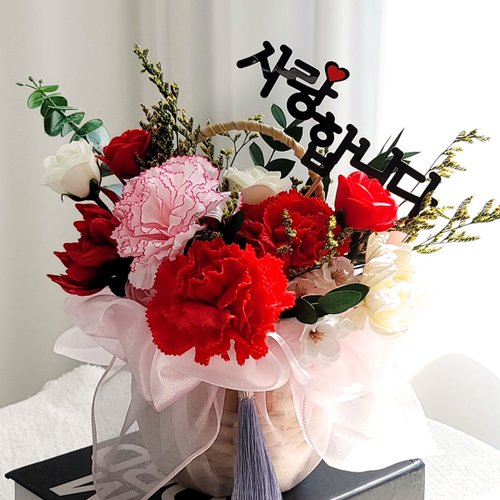
What a typical 어버이날 looks like
어버이날 isn't a public holiday, so offices and schools stay open.
However, the most common way to celebrate is with 식사, a meal together. Children treat their parents to dinner at a nice restaurant, or cook at home, letting the kids take care of the parents.
The other classic gesture is 용돈 — giving your parents cash.
It’s usually met with an “아이고...” here and an “뭘 이런걸...” there, but they take it eventually (only to give it back at some other chance.

So many creative ways to gift 용돈
효도
To really understand 어버이날, you need one more word: 효도.
효도 is often translated as "filial piety," but that phrase doesn't quite land in English. Think of it more simply as: taking care of the people who raised you.
어버이날 is essentially a national reminder to do 효도 and call your parents or take them out for dinner. Doesn’t even need to be that big of a deal — we all know parents are happy to hear from us every once in a while.
가정의 달: The Whole Month Is for Family
어버이날 doesn't stand alone, it’s part of a series of holidays that land in May.
In Korean, May is called 가정의 달, which means "the month of the family." And the whole month is structured around celebrating the people in your life.
어린이날 kicks things off on May 5th. 어린이 means "child" where kids get gifts, families head to amusement parks and zoos, and for that day, children are in charge of the itinerary.
Then comes 어버이날 on the 8th, which you now know all about.
The month closes with 스승의날 on May 15th — Teachers' Day. 스승 is a respectful, somewhat formal word for teacher, a step above the everyday 선생님. Students write letters of appreciation, and also purchase 카네이션 here too.
Happy 어버이날! Go call your parents! ☺️☎️
Enjoy this newsletter?
Subscribe to Daily Tokki Korean Learners to get new posts delivered to your inbox.